I hope you find this blog helpful as you plan your crowdfunding journey. If you’d like personalized support or expertguidance to help make your campaign a success, click here
Author: Adebayo Ogungbemile | Founder of Boostfunders
Equity crowdfunding has evolved rapidly over the last few years. What once felt like an experimental alternative to venture capital is now a legitimate fundraising path for startups, founders, and growth-stage companies worldwide.
In 2026, equity crowdfunding is no longer just about raising capital, it’s about building a community of investor-advocates, validating traction publicly, and unlocking funding opportunities that were once limited to elite networks.
In this guide, we’ll break down what equity crowdfunding is, how it works in 2026, the platforms driving the space, and what founders need to know before launching a raise.
Key Takeaways
- Equity crowdfunding allows startups to raise capital by selling shares to the public, not just accredited investors.
- In 2026, platforms emphasize traction, transparency, and marketing readiness, not just ideas.
- Regulation Crowdfunding (Reg CF) remains the most popular legal framework for U.S.-based equity raises.
- Successful equity campaigns rely heavily on pre-launch marketing, email lists, and external traffic.
- Platforms like Wefunder, StartEngine, and Republic reward momentum, not passive launches.
- Agencies like Boostfunders help founders bridge the gap between compliance and growth.
What Is Equity Crowdfunding?
Equity crowdfunding is a fundraising method that allows startups to raise money by offering ownership (equity) in their company to a large number of investors, often including non-accredited investors.
Instead of pitching only to venture capitalists or angel investors, founders can now raise capital publicly through regulated online platforms.
In simple terms:
- Investors receive shares or equity instruments
- Founders receive capital to grow the business
- Everyone participates under defined legal frameworks
This is fundamentally different from reward-based crowdfunding like Kickstarter or Indiegogo, where backers receive products, not ownership.
How Equity Crowdfunding Works in 2026 (Step by Step)
By 2026, equity fundraising is no longer about pitching an idea and hoping it resonates. Platforms, investors, and regulators expect founders to treat a raise as a formal business process. Preparation happens before the listing ever goes live, and the quality of that preparation often determines whether a raise gets approved or ignored.
Before launching, founders must prepare:
- A clear business model
This explains how the company creates value, who the customer is, and how revenue is generated. In 2026, platforms look for clarity and scalability, not vague monetization plans. - Financial projections
Typically spanning three to five years, projections must be grounded in real assumptions. Automated platform checks and investor scrutiny quickly expose unrealistic growth or weak unit economics. - Valuation and equity offer
Founders must justify their valuation using traction, market size, and comparable companies. A well-structured equity offer signals maturity and builds trust with investors from day one. - Legal disclosures required under regulation
These include risk disclosures, shareholder rights, cap table transparency, and compliance documentation. By 2026, most platforms standardize this process, but founders remain responsible for accuracy and completeness.
By this stage, ideas alone are rarely enough. In 2026, equity platforms expect founders to arrive prepared, credible, and ready to operate like a real company, not just a promising concept.
2. Platform Approval & Compliance
Once a company submits its listing, the process shifts from founder preparation to platform and regulatory review. In 2026, equity platforms act as both gatekeepers and compliance filters, ensuring only qualified companies reach public investors.
At this stage, platforms review:
- Business viability
Platforms assess whether the company is a legitimate operating business with a plausible path to growth. While platforms are not endorsing success, they are expected to screen out non-viable or misleading offerings. - Legal compliance
Equity crowdfunding platforms are registered with the U.S. Securities and Exchange Commission (SEC) and must operate within strict regulatory frameworks. Companies must meet eligibility requirements, including jurisdictional rules; most raises require the company to be based in the United States (and, on some platforms, Canada). - Disclosure completeness
Founders are required to provide standardized disclosures covering financials, use of funds, ownership structure, and material risks. Incomplete or inconsistent information is one of the most common reasons listings are delayed or rejected. - Risk transparency
Platforms closely review how risks are presented. By 2026, clear and honest risk disclosures are not optional; they are a regulatory expectation designed to protect less-experienced investors from misunderstanding the nature of early-stage investments.
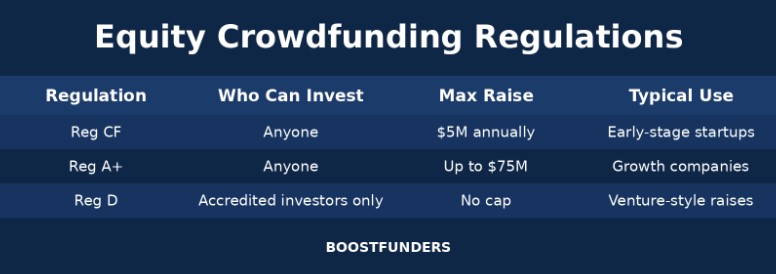
Most U.S.-based platforms operate under SEC-regulated fundraising exemptions, most commonly Regulation Crowdfunding (Reg CF). Reg CF allows startups to raise up to $5 to over $75 million per year from the general public, while imposing limits on how much individual investors can contribute based on income and net worth. These limits are designed to prevent individuals from becoming overly exposed to high-risk investments.
Some companies pursue higher fundraising caps through other SEC-regulated tiers, such as Regulation A offerings, which allow significantly larger raises over a 12-month period but come with stricter disclosure and reporting requirements.
3. The Campaign Goes Live
After approval, the campaign page goes live and includes:
- Pitch deck
- Founder story
- Financials
- Valuation & equity terms
- Investment minimums
At this stage, platforms do not bring investors automatically.
Just like Kickstarter, external traffic and early momentum matter, which is why many campaigns fail without proper marketing.
This mirrors how algorithms work in reward crowdfunding something we explain in depth in our guide: Kickstarter Algorithm: How to Rank Higher & Trend Fast
4. Investors Pledge Capital
Investors can:
- Invest small amounts (often starting from $100)
- Track progress publicly
- Ask founders questions
- Share campaigns socially
Investors expect regular updates, transparency, and responsiveness from founders.
5. Funds Are Released & Shares Issued
If the campaign meets its minimum raise:
- Funds are released to the company
- Equity instruments are issued
- Investors become shareholders (or holders of SAFE/notes)
If the minimum isn’t met, funds are typically returned.
Regulation Crowdfunding (Reg CF) Explained Simply
Regulation Crowdfunding commonly called Reg CF is the legal framework that makes equity crowdfunding possible in the United States. It was created under the JOBS Act (Title III) to allow startups and small businesses to raise capital from the general public through regulated online platforms.
Before Reg CF existed, investing in startups was mostly limited to venture capital firms and accredited investors. Today, Regulation Crowdfunding has opened private startup investing to a much broader audience while still maintaining important investor protections.
How Reg CF Works
Under Regulation Crowdfunding, a company can raise money by selling securities such as shares, SAFE agreements, or convertible notes to investors online through approved funding portals.
A typical Reg CF campaign works like this:
- The startup prepares the offering
The company sets a valuation, determines how much capital it wants to raise, and prepares required disclosures. - The offering is filed with the SEC
Companies must submit a document called Form C, which contains details about the business, financial statements, risks, and use of funds. - The campaign launches on a regulated platform
Fundraising must occur through SEC-registered crowdfunding portals or broker-dealers such as Wefunder, StartEngine, or Republic. - Investors pledge capital online
Both accredited and non-accredited investors can participate. - The company closes the round
Once the minimum funding goal is reached, funds are released and investors receive their equity instruments.
The SEC currently allows companies to raise up to $5 million in a 12-month period through Regulation Crowdfunding.
This increase implemented in recent regulatory updates made equity crowdfunding far more viable for serious startups.
For many early-stage companies, a Reg CF round can now fund:
- Product development
- Market expansion
- Hiring and team growth
- Manufacturing and supply chains
Who Can Invest in Reg CF Campaigns?
One of the most revolutionary aspects of Regulation Crowdfunding is that anyone can invest, not just wealthy investors.
Both accredited and non-accredited investors are allowed to participate, though there are annual limits designed to reduce financial risk.
For example:
- Investors with lower income or net worth may invest the greater of $2,500 or 5% of their income/net worth annually.
- Higher-income investors may invest up to 10% of their income or net worth, capped at roughly $124,000 per year.
These limits ensure that individuals can participate in startup investing while preventing excessive exposure.
This legal responsibility is why equity crowdfunding is not a “set it and forget it” strategy.
Reg CF vs Other Equity Crowdfunding Regulations
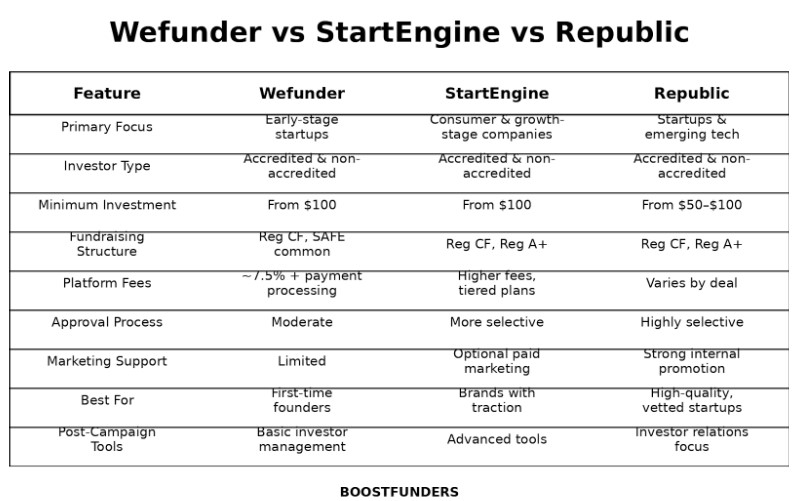
Top Equity Crowdfunding Platforms in 2026
Wefunder
One of the most founder-friendly platforms, known for early-stage startups and community-driven raises.
StartEngine
Popular with consumer brands and later-stage startups, often paired with aggressive marketing.
Republic
Strong brand credibility, selective approval process, and international reach.
Each platform has different:
- Fee structures
- Investor demographics
- Marketing expectations
Conclusion
Equity crowdfunding in 2026 represents one of the most significant shifts in how startups raise capital. Instead of relying solely on venture capital firms or angel networks, founders now have the ability to raise funds directly from their communities and supporters through regulated online platforms.
Frameworks like Regulation Crowdfunding (Reg CF) have opened the door for everyday investors to participate in startup growth while still maintaining investor protection through SEC-regulated platforms. As a result, platforms such as Wefunder, StartEngine, and Republic have become major gateways connecting founders with global investor communities.
However, launching an equity crowdfunding campaign successfully requires far more than simply listing a startup online. Founders must prepare a compelling narrative, demonstrate traction, build an audience, and drive investor momentum before and during the campaign.